The wild broccoli 🥦
Current mood: feeling
The emperor
Mood: 🎨 painterly written under the waning gibbous 🌖
Introduction
Emperor Huizong of the Song dynasty is generally remembered in popular history as a comically tragic (or tragically comic) figure: the emperor who disappeared into a fantasy world of fine art while his empire crumbled around him, ultimately losing the northern half of the empire to barbarian conquest by the Jurchens. However, this is a flattening of a complicated and sophisticated ruler, one which serves more as a convenient and simple morality tale like one of Aesop’s fables than an accurate portrayal of the real historical figure. In this way, we can compare the moralistic mythology around Huizong to that of the Roman emperor Nero, who similarly championed arts and culture during his rule only to eventually be overthrown and later be conflated in popular culture with the Antichrist, labeled a profligate who fiddled while Rome burned.
As an aside, I believe a large portion of Nero’s overwhelmingly negative historical characterization is due to the fact that he persecuted Christians during his rule, and in the current-day culturally Christian Western world, the historical Christian interpretation of Nero as an Antichrist figure becomes the dominant one. However, even during his rule, his pursuit of the arts alienated the aristocracy due to the costs of this patronage as well as the scandalous class-defying nature of an emperor moonlighting as a performer; history is often written from the perspectives of the aristocracy. This forms a parallel with Emperor Huizong, whose aesthetic pursuits were directly informed by the Daoist perspective of an ideal ruler; however, according to Ebrey1, this philosophical stance towards governance alienated the literati with their Confucian sentiments and contributed to Huizong being perceived as a corrupt and inept leader with serious issues in prioritization skills. This stance was later cemented into the annals of history by the humiliating defeat and occupation by the Jurchen Jin dynasty at the end of his rule.
Back to Emperor Huizong’s aesthetic pursuits, although it’s easy to consider Huizong a master of the gongbi fine-line style, and he is especially known for his flower-and-bird paintings, which was a popular subject during the Song dynasty, his style is far from generic. For example, in Pigeon on a Peach Branch, one can immediately see the level of detail and care in the portrayal of both the bird and the flower, with washes of colored ink blending into each other seamlessly and very fine brush strokes used to convey the fluffy texture of the bird’s feathers. The branch has subtle shading to convey dimensionality, but, critically, the pigeon itself is almost completely devoid of lighting that would convey the sense of a three-dimensional figure. In fact, many of Huizong’s paintings display this “flattening effect”. We can see here on the branch that he is perfectly capable of using ink wash shading to create a three-dimensional figure, so the flatness of the pigeon stands out even more as a conspicuous and deliberate choice.
 Emperor Huizong, Pigeon on a Peach Branch
This is, in fact, part of a larger trend in which Emperor Huizong eschews extraneous detail in his artistic process. In Auspicious Dragon Stone, the titular stone appears almost silhouette-like against the blank ground of the canvas, all context and sense of place disappeared into a pale void. Context is instead given by the written preface and accompanying poem to the left of the image. The stone itself is painted using tone-against-tone ink wash technique, with fine lines outlining the internal contours of the rocky projections and perforations of the limestone rock. In contrast with the stone and its tone-on-tone technique is a delicately painted leafy plant (perhaps a broad-leaf bamboo, but I could not identify the species entirely from the image) and small shrub. This stylistic contrast additionally appears as a repeated motif in Huizong’s work. However, again, the stone itself seems to lack a certain dynamic contrast in its shading that would convey a truly three-dimensional shape. Instead, it appears as a silhouette or perhaps like a relief sculpture, a projection onto the plane in two or maybe two-and-a-half dimensions.
 Emperor Huizong, Auspicious Dragon Stone

Maggie Bickford, in her writing on Emperor Huizong’s artistic corpus2, places his work not in the contemporary flower-and-bird tradition, but instead in the much more ancient tradition of “auspicious images”: schematics of various types of omens defined by their almost diagrammatic, encyclopedic character. In this recontextualization, the flatness of the bird and stone echoes the strong silhouettes of the catalogued omens and elevates what was traditionally perceived as a utilitarian decorative object into the world of fine art. Additionally, Bickford emphasizes the importance of the relationship between text and image in the composition of Huizong’s paintings; his work incorporates calligraphy and poetry and the interplay of text and image is central to his mastery of the Three Excellences (calligraphy, poetry, and painting). Huizong’s distinctive and unreproduced calligraphic style additionally created a seal of authenticity on his paintings that attested to the provenance of his work while allowing the work to remain “impersonal” and “without individual ideosyncrasy” as was befitting of an emperor.
Project
I set out to try and recreate the characteristics of this painting style in an image that paid tribute to Emperor Huizong, his life, and his work. However, as I do not have the raw materials to accurately reproduce fine-line gongbi and ink-wash painting, I settled for a digital pastiche.
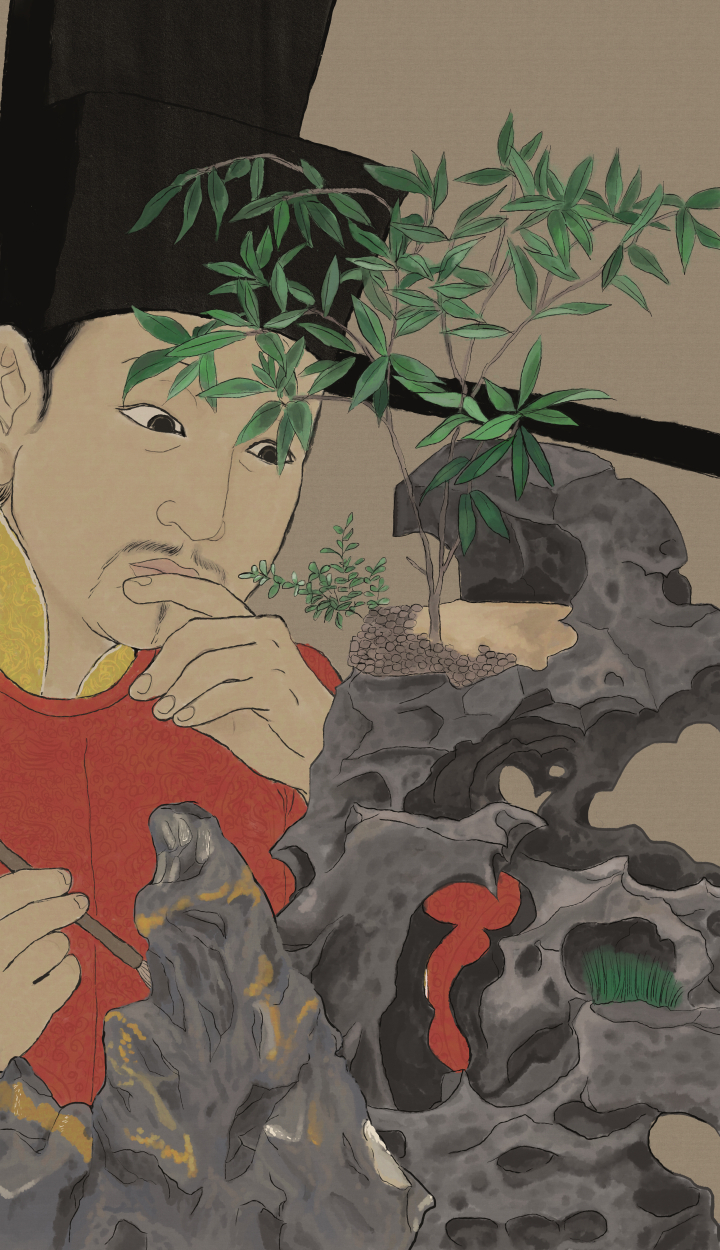
I first heard of Emperor Huizong when I learned the story of the imperial garden Genyue, which was a monumental project using rare stones, plants, and animals from all over the empire to create a truly beautiful microcosm of the empire within the confines of the city Kaifeng. Even an artificial mountain was created for the sake of the garden. It seems that the public opinion of the garden focused on its beauty and splendor, as attested by Zu Xiu3. Additionally, rhapsodies were written on the majesty and wonder of this garden, which one could interpret as a refutation of the idea that Emperor Huizong’s artistic and cultural pursuits were seen as wasteful and frivolous uses of imperial resources; but of course the true skeptic can say that as Huizong was a great patron of the arts and connoisseur of fine poetry, even without needing to exert explicit pressure on the authors of the rhapsody, an implicit pressure from the patronage system could compel one to write favorably on the emperor’s pastimes. Sadly, when the Jurchens invaded after a series of diplomatic missteps, the garden was dismantled for parts and the rare trees imported from all over the empire were burned for fuel by the starving inhabitants of the besieged city4.
This tragic tale moved me, and I thought how sad and dramatically ironic it was that a seeker of beauty could find such ruin, that a cataloguer of auspicious omens could reach such an ignoble end to his rule, and critically, how the fall of the empire in maximus was so paralleled in the destruction of the Genyue Marchmount as the empire in miniature. My original thought was to create a monumental landscape-style composition of the tiny plants and rocks Emperor Huizong collected to create a painting of contradictions: a monumental miniature. Originally, this would have been in the style of another Song-dynasty painter I admire, Guo Xi, whose writing on the three distances in landscape painting5 ultimately did end up informing the composition of the painting. However, in order to create a sense of scale, as many scholar’s rocks resemble mountains and my artistic skill might not be capable of drawing the distinction, I decided to include the emperor himself looking down over his composition. This doubled as a metaphor for the larger-than-life role all emperors had to mantle. However, after sketching the image, I decided that it would be better for me to try to paint in a pastiche of Emperor Huizong’s style instead.
In the material world, one begins a fine-line gongbi painting by preparing the silk canvas with a special treatment6. After drawing a sketch on rice paper, the sketch is meticulously traced in ink with a very fine brush to create the initial line art. After this, in order to create the intense saturation of color, a wash of opaque ink (either in a light color for parts of the painting intended to be light, or in a dark color for parts of the painting intended to be dark) is painted on the back of the canvas, creating a solid ground for the artist to paint over. After this, the base colors are painted on the front of the canvas, over the initial line art. To shade the painting, you can use two ink wash brushes in different colors and carefully alternate them to create subtle gradations of pigment. After this painstaking process is completed, the line art is once again drawn one more time in the places where it was obscured by the color work.
In a modern digital painting software, you can use digital layers to create this same effect. First, I created a layer for the sketch of the image, where I laid out the general composition of the painting. After this, I created a new layer out of the image of a blank silk canvas texture, while setting the opacity to show some of the sketch through the new layer. I then created a third layer where I traced over the sketch with a fine-line digital ink brush. With a drawing tablet, it is possible to program the width and opacity of the brush stroke to be based on the amount of pressure you place on the tablet. In this way, a fairly accurate simulation can be created of a traditional ink brush. After this, I hide the sketch layer and create a new layer underneath the “canvas” layer and fill it in with white or black ink wash depending on the color I intend to paint on top. Then I can create a new layer over top of the line art layer and start to paint the colors in with ink wash. To get the effect of the alternating brushes, there is a tool that allows you to save two colors at a time and switch between them at the press of a button; this is akin to using two brushes that are loaded with different colors and switching back and forth between them. Finally, I paint a thin line over top of the colored and shaded painting.
Artistically, I decided to make reference to two pieces of art referring to Emperor Huizong. The first is his own work, Auspicious Dragon Stone, while the second is his imperial portrait, which I used in order to try to capture his likeness.
 Artist unknown, Seated Portrait of Emperor Song Huizong
In Emperor Huizong’s own work portraying humans, he pays special attention to the details of the pattern on their clothing while keeping the rest of the person fairly flat. In this painting as well as the previous one, shading on the face and skin is very minimal, leading me to believe that this was the standard in portraiture for the time.
 Emperor Huizong after Zhang Xuan, Court ladies pounding silk

I thought I could recreate this sort of subtle textile detail in my version, but the painting I referenced did not show much detail on Huizong’s robe. I think at the time, the style may have been to be much more minimalistic and subdued in men’s fashion. Additionally, as a literati-emperor, Huizong might have followed the fashion trends of the literati rather than portray himself as wearing something overtly flashy for his portrait. However, I was able to find a painting of a different Song-dynasty ruler, which allowed me to see what kind of brocade and embroidery might be present on an emperor’s robe.
 Artist unknown, Seated Portrait of Emperor Song Xuanzu
.jpg)
When painting the Auspicious Dragon Stone, I too tried to focus on silhouette, shape, and surface elements rather than the three-dimensional figure of the stone. In fact, while painting, I found that I had accidentally not made the rock appear flat enough, so I deliberately restricted the range of color to make shading appear less intense. The second stone was based on a photo I found on Ebay of a cool looking rock that I hoped Emperor Huizong might appreciate for the spots of color and interesting texture.
There is so much to learn from studying Emperor Huizong’s technique and style. I noticed while looking at the leaves in the original painting of the Auspicious Dragon Stone that it seems like Emperor Huizong did not paint two iterations of the line art but rather painted the thin lines once and carefully painted in between them to create the thin branches and leaves. Additionally, the level of control over brush stroke and pressure is so much more masterful than what I can approximate, and in comparison, my lines can barely be called fine at all. I would like to continue practicing this style and method and hopefully be able to step outside of the digital world and learn how to create this sort of painting in the real world as well.
-
Ebrey, P. B. (2014). Emperor Huizong. Cambridge, Massachussetts: Harvard University Press. ↩︎
-
Bickford, M. (2006). Huizong’s Paintings: Art and the Art of Emperorship. In P. B. Ebrey, & M. Bickford (Eds.), Emperor Huizong and late Northern Song China: the politics of culture and the culture of politics (pp. 453-516). Cambridge, Massachussetts: Harvard University Asia Center. ↩︎
-
Zuxiu. (Song Dynasty). Record of the Florescent Solarity Palace. ↩︎
-
Hargett, J. M. (1988-1989). Huizong’s Magic Marchmount: The Genyue Pleasure Park of Kaifeng. Monumenta Serica, 1-48. ↩︎
-
Guo Xi. (Song Dynasty). The Lofty Message of Forest and Streams. ↩︎